Digitizing a photo collection is easier when your scanner can reduce the dust, scratches, and surface defects that become obvious in high-resolution files. Digital ICE technology helps automate that cleanup, while the right scanner also depends on your media type, workflow, and desired output quality.
We compare 10 photo scanners with digital ICE and related photo-focused models, from high-end flatbeds for film and enlargements to fast scanners designed for large print collections.
Best 10 Photo Scanners with Digital Ice Picks for 2026
Professional Choice
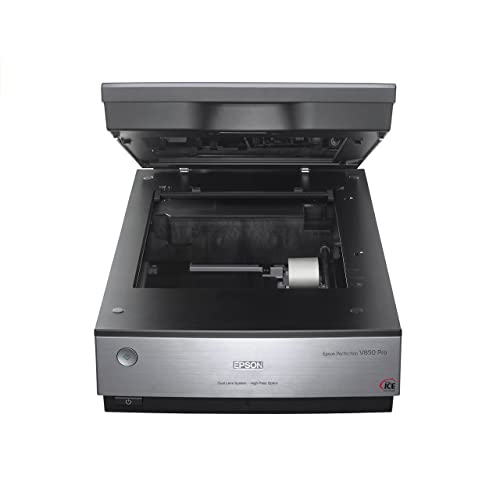
- 6400 dpi resolution with 4.0 Dmax
- Dual-lens system for optimized results
- CCD scanning with USB connectivity
Best For: Serious photo archivists and photographers
Easy Batch Digitizer

- Scans 4x6 photos in about two seconds
- Auto crop and deskew simplify cleanup
- Supports common prints and documents
Best For: Families digitizing standard-size photo collections
High-Speed Archive Pick

- Batch-scans up to 36 photos
- Up to one photo per second at 300 dpi
- USB and Wi-Fi connectivity with duplex scanning
Best For: Large photo archives and mixed document projects
Standalone Film Converter

- Converts several film and slide formats
- Standalone operation with no computer required
- 5-inch display and SD card storage
Best For: Film and slide owners wanting simple JPEG conversion
High-Resolution Choice
Epson Perfection V800 Photo Scanner

- 6400 dpi resolution for detailed scans
- 4.0 Dmax for shadow detail
- Dual-lens system supports photo and slide scanning
Best For: High-quality photo, negative, and slide scanning
Compact Everyday Option

- 4800 dpi optical resolution
- One-click faded-photo color restoration
- Lightweight, USB-powered flatbed design
Best For: Everyday home photo and document scanning
Best Wireless Photo Scanner

- Scans up to 100 photos per minute
- Includes photo carrier sheets
- Wi-Fi 6 and USB-C connectivity
Best For: Fast home photo and document digitization
Best Value Digital ICE Scanner

- Digital ICE removes apparent film dust and scratches
- 6400 dpi optical resolution
- Scans slides, negatives, photos, and documents
Best For: Film scanning and faded-photo restoration
Best Advanced Film Scanner

- Digital ICE supports dust and scratch removal
- Handles 35mm and medium-format film
- 6400 x 9600 dpi maximum resolution
Best For: High-resolution mixed photo and film archiving
Professional Choice – Epson Perfection V850 Pro
For demanding photo archives, the Epson Perfection V850 Pro is a strong option among photo scanners with digital ice. Its 6400 dpi resolution, CCD sensor, 4.0 Dmax, and dual-lens system are designed for detailed scans with smooth tonal transitions and fine shadow detail.
Best For: Photographers, collectors, and serious archivists who prioritize scan quality over speed or portability.
Pros:
- 6400 dpi resolution and up to 9600 dpi listed scanner resolution support detailed scans
- 4.0 Dmax helps preserve smooth gradations and shadow detail
- Dual-lens system selects a lens for the scanning task
- Supports Windows and Mac operating systems listed in the specifications
Cons:
- At 20.9 pounds, it is considerably less portable than compact photo scanners
- USB connectivity may be less convenient than a wireless setup
- Its pro-oriented capabilities may be more than casual users need
The V850 Pro is best suited to users who want maximum control and image quality for a long-term photo digitization project. It is a substantial investment, but its resolution, tonal range, and dual-lens design make it the quality-focused choice in this group.
Easy Batch Digitizer – Plustek ePhoto Z300
The Plustek ePhoto Z300 is a practical pick among photo scanners with digital ice for quickly converting common prints. It scans a 4×6 photo in about two seconds, automatically crops and deskews images, and supports several photo sizes plus letter- and A4-size documents.
Best For: Families and casual users who want a straightforward way to digitize large collections of standard-size prints.
Pros:
- Scans 4×6 photos in about two seconds at the stated setting
- Automatic crop and deskew reduce manual cleanup
- Supports 3×5, 4×6, 5×7, 8×10, letter, and A4 media
- Works with both Windows and Mac systems listed in the notes
Cons:
- Optical resolution tops out at 600 dpi
- Photos must be inserted one at a time
- USB connection requires a nearby computer
The Z300 emphasizes ease and throughput rather than maximum archival resolution. Its compact, feed-through design and enhancement tools make it a sensible choice for everyday prints and large family-photo projects.
High-Speed Archive Pick – Epson FastFoto FF-680W
The Epson FastFoto FF-680W is built for high-volume projects and stands out among photo scanners with digital ice for its speed and batch handling. It can scan up to 36 photos at once, capture a photo and handwritten notes on its back in one pass, and connect over USB or Wi-Fi.
Best For: Users digitizing thousands of prints who also want document scanning, automatic enhancements, and wireless sharing or backup.
Pros:
- Scans at up to one photo per second at 300 dpi
- Batch-scans up to 36 photos and supports multiple sizes in one batch
- Duplex scanning captures photos and handwritten notes on the backs
- Includes auto enhancement, color restoration, red-eye reduction, crop, and deskew tools
Cons:
- Its automatic document-feeder design may be less suited to delicate or unusual originals than a flatbed
- Listed resolution is 600 dpi, with higher-resolution modes affecting workflow and file size
- It is larger and heavier than a basic compact photo scanner
The FF-680W is the productivity choice for large archives. Its batch workflow, duplex capability, Wi-Fi, and included carrier sheet make it especially useful when speed and organization matter as much as image enhancement.
Standalone Film Converter – Magnasonic FS71 Film Scanner
The Magnasonic FS71 takes a different approach from flatbed photo scanners with digital ice by converting film and slides directly into JPEG files. It supports 35mm, 110, 126, and Super 8 film plus 135, 126, and 110 slides, and it can save scans to an SD card without a computer.
Best For: Users who primarily need a simple, standalone way to digitize film negatives and slides.
Pros:
- Converts multiple film and slide formats into 24MP JPEG files
- Works without a computer or driver installation
- Built-in 5-inch display supports direct viewing and adjustment
- Saves images to SD cards up to 128GB and scans in less than five seconds each
Cons:
- Designed for film and slides rather than standard paper photo prints
- SD card is not included
- HDMI cable for TV or monitor viewing is not included
The FS71 is the most convenient option here for film-focused digitization. Its standalone operation and broad format support are useful when you want quick JPEG files without setting up a computer-based scanning workflow.
High-Resolution Choice – Epson Perfection V800 Photo Scanner
The Epson Perfection V800 is a strong option for shoppers seeking photo scanners with digital ICE-style restoration needs and high-end image quality. Its 6400 dpi resolution, 4.0 Dmax, 16-bit grayscale depth, and dual-lens system are designed for detailed scans with smooth tonal transitions. It also supports photos and slides.
Best For: Photographers and archivists who prioritize high resolution, tonal detail, and film or slide scanning.
Pros:
- 6400 dpi resolution captures fine image detail.
- 4.0 Dmax helps preserve shadow detail and smooth gradations.
- Dual Lens System selects between two lenses for different scanning needs.
- Supports photo and slide media with 48-bit color depth.
Cons:
- At 20.9 pounds, it is relatively heavy for a home scanner.
- USB connectivity may be less convenient than wireless scanning.
- The supplied operating-system list does not mention newer Windows or macOS versions.
The V800 is the most specialized choice in this group for demanding photo work. Its resolution and tonal-range specifications make it particularly appealing when scan quality matters more than compactness or speed.
Fast Batch Scanning Pick – Canon imageFORMULA RS40
The Canon imageFORMULA RS40 is a practical choice among photo scanners with digital ICE-style enhancement features, especially for large batches of mixed photos and documents. Its automatic feeder scans both sides at up to 40 items per minute, while bundled software adds red-eye correction, digital face smoothing, and other photo tools.
Best For: Families and home users digitizing varied photo collections, receipts, cards, and documents quickly.
Pros:
- Automatic feeder holds up to 60 sheets.
- Scans both sides of photos and documents at up to 40 items per minute.
- Bundled software includes red-eye correction and digital face smoothing.
- Handles Polaroids, receipts, cards, IDs, and other varying media sizes.
Cons:
- Its 8-bit color and grayscale depth are lower than the Epson flatbed models listed here.
- It uses a CIS sensor rather than a CCD sensor.
- The highest listed 1200 dpi setting is interpolated.
The RS40 favors convenience and throughput over maximum archival resolution. Choose it when feeding many mixed-size originals efficiently is more important than achieving the highest bit depth or optical resolution.
Compact Everyday Option – Epson Perfection V19 II
The Epson Perfection V19 II is a compact flatbed option for shoppers comparing photo scanners with digital ICE-style color restoration features. Its 4800 dpi optical resolution suits photo enlargements, and Easy Photo Fix can restore faded colors with one click. USB power, one-touch buttons, and a removable lid make it convenient for everyday scanning.
Best For: Home users who want an affordable, lightweight scanner for photos, artwork, books, and occasional documents.
Pros:
- 4800 dpi optical resolution supports detailed photo enlargements.
- Easy Photo Fix restores color to faded photos with one click.
- Compact 3.1-pound design is USB powered and easy to store.
- Removable high-rise lid accommodates books and photo albums.
Cons:
- Its one-sheet flatbed design is slower for large collections than an automatic feeder.
- It does not list slide or negative scanning support.
- USB connectivity requires a computer connection for operation.
The V19 II is a sensible everyday flatbed when space, simplicity, and faded-photo correction matter. It offers strong resolution in a lightweight design, but batch-scan users may prefer the Canon RS40.
Best Wireless Photo Scanner – ScanSnap iX2500 Photo Edition
The ScanSnap iX2500 Photo Edition is a practical choice for quickly digitizing photo collections and documents. It includes three photo carrier sheets for delicate prints, scans up to 100 photos per minute, and offers wireless or USB connectivity. However, the supplied specifications do not identify Digital ICE technology, so it may be better suited to streamlined everyday scanning than specialized dust-and-scratch restoration.
Best For: Families and home users who want fast photo and document scanning with Wi-Fi, touchscreen controls, and cloud support.
Pros:
- Includes three photo carrier sheets for delicate prints.
- Scans up to 100 photos per minute, with an ADF capacity of up to 36 photos.
- Offers Wi-Fi 6, USB-C, automatic optimization, and cloud-service support.
- Large touchscreen supports customizable scanning profiles.
Cons:
- Digital ICE technology is not listed in the supplied specifications.
- Its 600 dpi resolution is lower than the Epson flatbed models in this roundup.
- As a document-style scanner, it may be less suitable for film and slide scanning.
The iX2500 stands out for speed, organization, and flexible connectivity. Choose it when convenient batch scanning matters more than film support or a specifically documented Digital ICE workflow.
Best Value Digital ICE Scanner – Epson Perfection V550
The Epson Perfection V550 is a strong fit for shoppers specifically seeking photo scanners with Digital ICE. Its 6400 dpi optical resolution, built-in transparency unit, and Digital ICE technology support detailed scanning and dust-and-scratch removal for film. It also includes Easy Photo Fix for one-touch faded-photo restoration.
Best For: Users restoring prints, 35mm slides, and negatives who want high resolution and built-in Digital ICE features.
Pros:
- Includes Digital ICE technology for removing the appearance of dust and scratches on film.
- 6400 dpi optical resolution supports enlargements up to 17 by 22 inches.
- Scans 35mm slides, negatives, photos, and documents.
- Can scan multiple photos and save them as separate files with automatic edge detection.
Cons:
- Uses wired Hi-Speed USB 2.0 connectivity only.
- The supplied minimum system requirement lists Windows 7, so compatibility with newer systems should be checked.
- Its flatbed design has a one-sheet standard capacity.
The V550 offers the essential restoration tools for film and faded prints without sacrificing high-resolution output. It is a sensible choice for archival projects, provided USB connectivity and software compatibility meet your needs.
Best Advanced Film Scanner – Epson Perfection V600
The Epson Perfection V600 is designed for high-resolution photo and film digitization, making it one of the more capable photo scanners with Digital ICE in this roundup. It handles 35mm and medium-format film, offers up to 6400 by 9600 dpi, and includes Digital ICE alongside photo-restoration software.
Best For: Photographers and archivists converting mixed print, 35mm, and medium-format film collections into detailed digital files.
Pros:
- Includes Digital ICE for dust and scratch removal.
- Supports 35mm mounted slides, up to 12 negatives, and medium-format film up to 6 by 22 cm.
- Maximum resolution of 6400 by 9600 dpi supports enlargements up to 17 by 22 inches.
- Includes Easy Photo Fix and ArcSoft PhotoStudio for restoration and enhancement.
Cons:
- Connectivity is limited to wired Hi-Speed USB 2.0.
- Its large flatbed footprint may require substantial desk space.
- The supplied minimum system requirement lists Windows 7, so current operating-system compatibility should be verified.
The V600 is the most versatile option here for users working with both prints and multiple film formats. Its Digital ICE support and included holders make it particularly appealing for serious home archiving, though it is less convenient than a wireless scanner.
How We Picked the Best Photo Scanners with Digital Ice
We focused on scanners suited to preserving printed photos, negatives, slides, and family archives. Our evaluation emphasizes optical resolution, film support, Digital ICE or comparable dust-and-scratch correction, color depth, scanning speed, software, connectivity, and ease of handling mixed-size originals. We also considered whether each model is best for occasional home use, detailed restoration work, or high-volume digitization.
Not every scanner serves the same purpose. Some products are flatbed models built for careful, high-resolution scans, while others use feeders or dedicated film paths to process collections more quickly. Confirm the exact media and correction features supported by the model before buying.
Quick Comparison
| Need | Best fit | Why it matters |
|---|---|---|
| Highest-quality film and print work | High-resolution flatbed | Offers detailed scans, film holders, and greater control over output. |
| Large print collections | Photo feeder scanner | Speeds up batches with automatic feeding and image processing. |
| Simple 4×6 photo scanning | Compact photo scanner | Reduces setup time and makes routine snapshots easier to process. |
| Slides and negatives without a computer | Standalone film scanner | Provides a display and direct file transfer for convenient conversions. |
Key Buying Factors for Photo Scanners with Digital Ice
Digital ICE Compatibility
Digital ICE uses infrared information to identify dust and scratches on supported film and transparencies, reducing manual retouching. Support varies by scanning mode and media type, and it may not work on every black-and-white film or reflective print. Check the manufacturer’s specifications rather than assuming the feature applies universally.
Optical Resolution and Real Detail
Optical resolution is more useful than an inflated interpolated number. For ordinary prints, 300 to 600 dpi is often enough for sharing and reprints. Film, cropping, and large enlargements benefit from higher optical resolution, although file sizes and scan times increase significantly.
Flatbed Versus Feeder
Flatbeds are safer for fragile, unusual, or valuable originals and usually provide more control. Feeders are much faster for loose prints but require clean, reasonably flat photos and careful attention to rollers. If your collection includes both delicate prints and standard snapshots, a flatbed may be the more flexible choice.
Film Formats, Software, and Output
Check whether the scanner accepts 35mm negatives, mounted slides, medium format, 110, 126, or other formats you own. Look for included holders, color correction tools, OCR, batch scanning, and support for your operating system. USB is common, while wireless connectivity can simplify placement and sharing.
Who Should Buy Which Photo Scanners with Digital Ice?
Choose a high-end flatbed if you are restoring film, scanning artwork, making enlargements, or need maximum control over color and resolution. Choose a fast photo feeder if your priority is digitizing hundreds or thousands of standard prints with minimal manual handling. Choose a compact photo scanner for straightforward 4×6 snapshots and occasional household archiving. Choose a standalone film scanner if you mainly convert slides and negatives and want a simpler workflow that does not depend on a full computer setup.
Before ordering, estimate your collection size, identify every film format involved, and decide whether convenience or restoration quality matters more. The best photo scanner is the one that supports your originals without adding unnecessary steps to the archiving process.