Digitizing a family photo collection is easier when you choose a scanner that matches the size, condition, and variety of your archive. The right model can turn boxes of prints into organized digital files without sacrificing detail or spending every weekend on manual scans.
This roundup compares 10 photo scanners for family archives, from high-speed automatic feeders to flatbed models designed for fragile prints, documents, negatives, and oversized memories.
Best 10 Photo Scanners for Family Archives Picks for 2026
Best High-Volume Pick

- Scans up to 36 photos per batch
- Duplexes photos and handwritten backs
- Wireless, enhanced, and cloud-ready
Best For: Large family archives and mixed-size photo collections
Best Simple Batch Alternative

- Scans 4x6 photos in about two seconds
- Supports common photo and paper sizes
- Includes auto crop, deskew, and restoration
Best For: Straightforward Mac or PC photo digitizing
Best Legacy High-Speed Pick
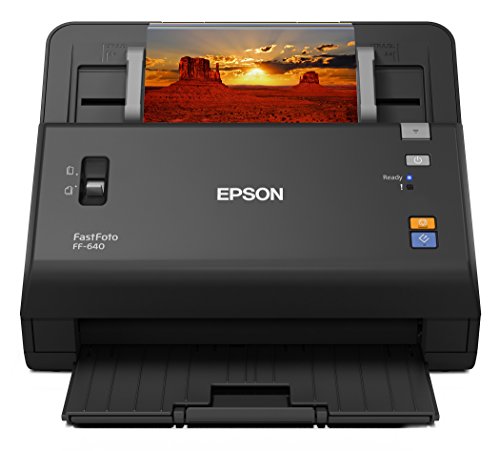
- Rated up to one photo per second
- Feeds up to 30 photos automatically
- Scans wallet-size through panoramic photos
Best For: Fast, USB-connected photo archiving
Best Flatbed Detail Pick

- High-resolution 4800 x 4800 dpi scanning
- 48-bit color with restoration tools
- Slim design with USB Type-C power and data
Best For: Detailed scans and occasional photo or document work
Best for Easy Setup

- 4800 dpi optical resolution
- Easy Photo Fix color restoration
- Compact USB-powered design
Best For: Detailed scans of photos, albums, artwork, and documents
Best Standalone Simplicity
Pandigital PANSCN06 Photo Scanner

- No PC needed while scanning
- Direct SD-card storage
- 600 dpi photo scanning
Best For: Simple photo digitizing with portable SD-card transfers
Best High-Capacity Pick

- Up to 100 photos per minute
- Wi-Fi 6, USB-C, and cloud support
- Automatic file naming and sorting
Best For: Large family archives and mixed photo-document batches
Best for Film and Restoration

- Scans slides, negatives, film, and prints
- 6400 dpi optical resolution
- Digital ICE and photo restoration tools
Best For: Film collections and detailed photo restoration
Best Compact Flatbed Value

- 4800 dpi optical resolution
- Removable lid for albums and books
- USB-powered, compact design
Best For: Everyday family prints and album scanning in small spaces
Best High-Volume Pick – FastFoto FF-680W
For families digitizing large collections, the Epson FastFoto FF-680W is a practical choice among photo scanners for family archives. It can batch-scan up to 36 photos and scan 4×6-inch images at up to one photo per second at 300 dpi, while supporting photos up to 8×10 inches, panoramas, postcards, and Polaroids.
Best For: Large family archives, mixed photo sizes, and users who want wireless sharing and automatic image enhancements.
Pros:
- High-speed batch scanning with a 36-photo capacity.
- Duplex scanning captures handwritten notes on photo backs.
- Offers auto enhancement, color restoration, red-eye reduction, cropping, rotation, and de-skewing.
- Supports 300 dpi sharing, 600 dpi TIFF archiving, and 1200 dpi enlargements.
Cons:
- At 8.2 pounds, it is less convenient to move than a compact flatbed scanner.
- Its broad features may be more than needed for occasional scanning.
The FF-680W is the strongest all-around option here for serious archive projects. Wireless connectivity, cloud backup support, OCR, and a carrier sheet add flexibility, while SafeTouch technology helps accommodate delicate photos.
Best Simple Batch Alternative – Plustek ePhoto Z300
The Plustek ePhoto Z300 offers a straightforward way to build photo scanners for family archives around a compact USB workflow. It scans a 4×6-inch photo in about two seconds at 300 dpi, supports several common photo sizes, and includes automatic cropping and deskewing.
Best For: Families seeking an easy desktop scanner for high-volume photo transfers on Mac or PC.
Pros:
- Scans 4×6-inch photos in about two seconds at 300 dpi.
- Supports 3×5, 4×6, 5×7, 8×10, letter, and A4 media.
- Includes image enhancement and restoration tools for faded photos.
- Works with Windows 7 through 11 and Mac OS X 10.12 through 15.x.
Cons:
- Photos must be inserted one at a time.
- USB connectivity does not offer the wireless placement flexibility of some alternatives.
With its simple feed-through design and support for common photo formats, the Z300 is a sensible middle ground between a flatbed and a more feature-rich automatic feeder. Its 600 dpi maximum resolution also leaves room for higher-detail scans.
Best Legacy High-Speed Pick – FastFoto FF-640
The Epson FastFoto FF-640 is designed for quickly processing a substantial collection of prints, making it a capable option among photo scanners for family archives. Its auto-feed tray holds up to 30 photos, and Epson rates it at up to one photo per second when scanning 4×6-inch photos at 300 dpi.
Best For: High-volume users who need fast photo feeding and scans up to 600 dpi.
Pros:
- Scans thousands of photos at a rated speed of up to one photo per second.
- Auto-feed tray accommodates up to 30 photos.
- Handles formats from wallet-size images to panoramic photos.
- Includes a carrier sheet and cleaning cloth for scanning support.
Cons:
- Uses USB rather than wireless connectivity.
- Listed minimum system requirements specify Windows 7.
- Its supplied notes do not specify duplex scanning or cloud backup features.
The FF-640 focuses on the core job of moving a large number of photos into digital form quickly. It is worth considering when feeder speed and a 30-photo tray matter more than newer wireless and sharing conveniences.
Best Flatbed Detail Pick – CanoScan LiDE 400
Canon CanoScan LiDE 400 Slim Scanner, 7.7" x 14.5" x 0.4", Document & Photo Scanner, Black
Check Price On AmazonThe Canon CanoScan LiDE 400 takes a different approach to photo scanners for family archives: it is a slim flatbed designed for individual photos and documents. Its 4800 x 4800 dpi resolution, 48-bit color depth, and dust-removal and color-restore features favor detailed, carefully prepared scans over high-volume feeding.
Best For: Users who prioritize high-resolution scans, a compact design, and occasional photo or document scanning.
Pros:
- Provides 4800 x 4800 dpi resolution and 48-bit color depth.
- Includes color restoration and dust removal enhancements.
- Scans in as fast as eight seconds and connects with one USB Type-C cable for data and power.
- Built-in buttons support auto scanning and searchable, editable multi-page PDFs.
Cons:
- Its standard sheet capacity is one, so it is slower for large archives.
- USB connectivity limits wireless placement options.
- Individual placement is less efficient than an automatic photo feeder.
The LiDE 400 is a strong fit for treasured images that deserve careful, high-detail capture rather than rapid batch processing. Its slim 0.4-inch profile and included vertical stand also make it easier to accommodate in a small workspace.
Best for Easy Setup – Epson Perfection V19 II
For family archives where image quality matters most, the Epson Perfection V19 II is a practical flatbed choice. Its 4800 dpi optical resolution is suited to detailed photo scans and enlargements, while the removable lid helps accommodate books and photo albums.
Best For: Families digitizing individual photos, artwork, albums, and documents with an emphasis on detail.
Pros:
- 4800 dpi optical resolution captures fine image detail.
- Easy Photo Fix can restore color to faded photos with one click.
- USB-powered, compact, lightweight, and equipped with a vertical kickstand.
- ScanSmart supports searchable PDFs and OCR document conversion.
Cons:
- The flatbed design requires placing items on the glass one at a time.
- It connects via USB rather than a wireless connection.
- Its listed minimum system requirement is Windows 7.
The V19 II is a strong fit for careful, high-resolution family scanning projects, especially when preserving photo detail is more important than processing a large stack quickly.
Best for Batch Scanning – Canon imageFORMULA RS40
For family archives with many photos and documents, the Canon imageFORMULA RS40 emphasizes speed and convenience. Its automatic feeder scans photos and documents, including items in varying sizes, and can scan both sides at once at up to 40 items per minute.
Best For: Families processing large batches of mixed photos, receipts, cards, and documents on Windows or Mac.
Pros:
- Automatic feeder holds up to 60 items.
- Duplex scanning handles both sides of photos and documents in one pass.
- Bundled software includes photo enhancement, red-eye correction, and face smoothing.
- Supports varied media and output formats including JPG, TIF, PNG, PDF, and PPTX.
Cons:
- It is heavier and larger than a compact flatbed scanner.
- Its listed optical resolutions are lower than the Epson V19 II’s 4800 dpi.
- It requires USB connectivity and draws more power than the USB-powered Epson.
The RS40 is the more efficient choice for an archive workflow built around batches. Its feeder, duplex scanning, and included enhancement tools can reduce hands-on work when digitizing a varied collection.
Best Standalone Simplicity – Pandigital PANSCN06 Photo Scanner
The Pandigital Personal Photo Scanner/Converter offers a straightforward way to digitize family photos without a computer during the scanning process. It scans photos up to 8.5 by 11 inches at 600 dpi and saves directly to an SD card.
Best For: Users who want a lightweight photo-scanning setup with direct SD-card storage and no PC required.
Pros:
- Scans photos up to 8.5 by 11 inches at 600 dpi.
- Works without a PC for a simpler archive workflow.
- Includes a five-in-one card reader for SD, MS, MSPRO, MMC, and XD cards.
- Lightweight at 1.6 pounds.
Cons:
- Its 600 dpi resolution is lower than the Epson V19 II’s 4800 dpi.
- The supplied notes identify it as a photo scanner rather than a document scanner.
- Storage and transfer rely on SD-card use or USB connection.
The PANSCN06 is appealing for simple, portable photo transfers and basic family archiving. Choose a higher-resolution flatbed if you expect to make large enlargements or need broader document-scanning features.
Best High-Capacity Pick – ScanSnap iX2500 Photo Edition
For families digitizing large boxes of prints, the ScanSnap iX2500 Photo Edition is a fast, flexible choice among photo scanners for family archives. Its automatic document feeder can hold up to 36 photos, while built-in optimization, file organization, Wi-Fi, and USB connectivity simplify high-volume projects.
Best For: Families scanning large batches of photos and documents who want wireless convenience and automated organization.
Pros:
- Scans up to 100 photos per minute and includes three photo carrier sheets for delicate prints.
- Automatic optimization, naming, and sorting can streamline archive management.
- Large touchscreen, Wi-Fi 6, USB-C, and cloud-service support offer flexible workflows.
Cons:
- Its 600 dpi resolution is lower than the flatbed Epson models in this roundup.
- The feeder holds up to 36 photos, so unusually large prints or fragile originals may require extra handling.
The iX2500 stands out when speed and organization matter most. It is a practical archive-building tool, particularly for families with substantial photo collections and mixed documents.
Best for Film and Restoration – Epson Perfection V550
The Epson Perfection V550 is a strong option for family archives that include prints, slides, and negatives. Its 6400 dpi optical resolution, built-in transparency unit, Digital ICE technology, and one-touch photo restoration tools are designed for detailed preservation work.
Best For: Families archiving film negatives, 35mm slides, and faded or scratched photos alongside standard prints.
Pros:
- Scans 35mm slides, negatives, film, photos, and documents.
- 6400 dpi optical resolution and 48-bit color depth support detailed reproductions.
- Digital ICE helps reduce the appearance of dust and scratches on film, while Easy Photo Fix restores faded photos.
- Can scan multiple photos at once and save each as a separate file with automatic edge detection.
Cons:
- USB is the only listed connection type.
- The large, 9.6-pound flatbed design takes more workspace than a compact scanner.
- The supplied minimum system requirement lists Windows 7, so current computer compatibility should be checked.
The V550 is the most versatile choice here for film-based family memories and restoration-oriented projects. It is better suited to careful, high-detail scanning than rapid feeder-based digitization.
Best Compact Flatbed Value – Epson Perfection V39
The Epson Perfection V39 is a space-conscious choice for families looking for straightforward photo scanners for family archives. It combines 4800 dpi optical resolution with color restoration, dust correction, cloud scanning, and a USB-powered design that fits easily into a home workstation.
Best For: Families scanning everyday prints and albums who want a compact, easy-to-use flatbed scanner.
Pros:
- 4800 dpi optical resolution captures detailed photo scans.
- Easy Photo Fix restores faded color, while Digital Dust Correction helps remove dust from scans.
- Removable high-rise lid accommodates books and photo albums.
- USB power, a built-in kickstand, and scan-to-cloud support suit small workspaces.
Cons:
- It scans one item at a time rather than using an automatic document feeder.
- USB is the only listed connection type, with no wireless option.
- The supplied minimum system requirement lists Windows 7, so compatibility should be confirmed before purchase.
The V39 is a practical fit for gradual, hands-on archiving rather than high-volume batches. Its removable lid and compact vertical-storage design are especially useful for scanning albums and oversized originals at home.
How We Picked the Best Photo Scanners for Family Archives
We focused on the practical demands of home archiving: scan speed, paper handling, image quality, software convenience, connectivity, and the ability to handle different photo sizes. Models with automatic feeders are especially useful for large collections, while flatbed scanners offer more control for delicate, curled, mounted, or unusually sized photographs.
We also considered optical resolution rather than relying only on advertised interpolation, along with features such as automatic cropping, deskewing, duplex scanning, cloud support, wireless operation, and film or negative scanning. The best choice depends less on having the highest specification and more on how closely the scanner fits your collection and workflow.
Quick Comparison
High-speed feeder models are the most efficient choice for hundreds or thousands of loose prints. They can process batches with minimal handling, but they may be less suitable for fragile originals or photographs with unusual dimensions. Flatbed models take longer because each image is placed individually, yet they generally provide greater flexibility and safer handling.
Dedicated photo scanners are convenient for common snapshot sizes, while document-oriented models can be a better all-purpose choice if you also need to digitize letters, receipts, and records. Film-capable flatbeds are worth considering when your archive includes negatives or slides.
Key Buying Factors for Photo Scanners for Family Archives
Collection Size and Scan Speed
Estimate how many prints you need to digitize. For a few albums, a flatbed may be perfectly adequate. For several boxes, look for an automatic photo feeder, batch scanning, and automatic image separation. Faster scanning can make a major difference when the project involves thousands of photographs.
Photo Condition and Handling
Old, thin, curled, cracked, or valuable prints deserve careful handling. A flatbed lets you position each item precisely and avoids feeding originals through a transport path. Use a clean glass surface and handle photographs by their edges to reduce dust and fingerprints.
Resolution and File Quality
For standard prints, 300 to 600 dpi is usually sufficient for sharing and reprinting. Higher optical resolution is useful when cropping, enlarging, restoring, or scanning small originals. Save archival masters as high-quality TIFF files when practical, then create smaller JPEG copies for everyday use.
Software and Organization
Automatic cropping, deskewing, color restoration, dust reduction, and searchable file organization can save substantial time. Check operating-system compatibility and decide whether you prefer USB, wireless, or cloud-enabled workflows before buying.
Who Should Buy Which Photo Scanners for Family Archives?
Choose a high-speed feeder scanner if your priority is digitizing a large collection quickly. Pick a flatbed photo scanner if image control, delicate originals, or mixed media matter more than throughput. A compact budget model suits occasional scanning, while a film-capable scanner is the better investment for families preserving negatives and slides as well as prints.
Whichever model you choose, create a consistent folder structure, keep at least two backups, and record useful details such as names, dates, and locations while the memories are still identifiable.