The best cordless belt sanders combine fast material removal with the freedom to work without an extension cord. They range from full-size 3-by-18-inch tools for broad surfaces to compact bandfiles for edges, curves, and detail work.
This roundup compares 10 options across major battery platforms and tool-only formats, helping you match belt size, speed control, ergonomics, and accessory support to your projects.
Best 10 Cordless Belt Sanders Picks for 2026
Best Overall
DEWALT 20V MAX Brushless Belt Sander

- Brushless 20V MAX motor
- Variable speed with 25-position dial
- Large sanding area and tool-free belt changes
Best For: Large sanding jobs and DEWALT 20V MAX users
Best for Metalwork
Milwaukee M12 FUEL Spot Sander

- Two speed settings plus variable trigger
- 360-degree rotating arm
- Designed for spot solder removal
Best For: Metalwork and tight, difficult-to-reach areas
Best Bandfile
DEWALT 20V MAX XR Cordless Bandfile

- 700 MWO brushless motor
- Up to 5,600 feet per minute
- 104-degree rotating arm and changeable contact arm
Best For: Detail sanding and narrow-surface work
Best Budget Detailer
WEN 6307 Variable-Speed File Sander
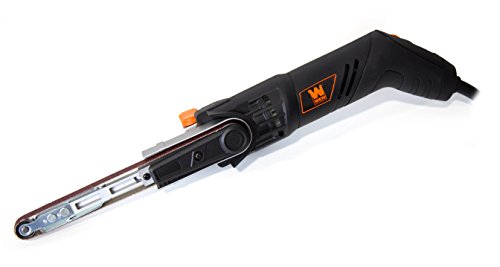
- Corded 1/2-by-18-inch detailing sander
- Variable speed from 1,080 to 1,800 FPM
- Includes three belts and automatic tracking
Best For: Budget-friendly detail sanding without batteries
Best Compact 18V Option
Brushless 3 in. x 18 in. Belt Sander

- 18V brushless, battery-powered design
- 3-by-18-inch sanding format
- 7.4-pound listed weight
Best For: Portable sanding with an 80-grit belt
Best Controlled Material Removal
Milwaukee M18 FUEL Belt Sander

- 750–1,350 SFM variable-speed range
- Brushless motor with REDLINK PLUS protection
- Tool-free belt replacement lever
Best For: Adjustable sanding and faster belt changes
Best for Detail Access
20V Adjustable Bandfile Sander

- Six speeds up to 3,268 ft/min
- 170-degree rotating sanding arm
- Includes five 1/2-by-18-inch belts
Best For: Angled wood and metal detail work
Best Milwaukee-Compatible Detail Sander

- Brushless motor reaches up to 3,268 ft/min
- Six speeds and a 170° rotating arm
- Includes five belts; battery and charger sold separately
Best For: Milwaukee battery owners sanding metal, wood, and tight areas
Best DeWalt-Compatible Detail Sander

- Compatible with DeWalt 20V MAX batteries
- Six speeds and a 170° adjustable sanding arm
- Includes five belts; tool-only package
Best For: DeWalt users handling detail sanding and metal or wood cleanup
Best Belt-and-Arm Kit
Ecarke 20V Cordless Belt Sander

- Includes 16 belts from 40 to 120 grit
- 120° adjustable body and two fixed arms
- Six speeds with up to 2,100 ft/min output
Best For: DeWalt users wanting varied grits for wood, metal, and plastic
Best Overall – DEWALT 20V MAX Brushless Belt Sander
For demanding cordless belt sanders applications, the DEWALT DCW220B combines a brushless motor, variable speed control, and a larger sanding surface designed for substantial jobs. It is sold as a bare tool, so you will need a compatible DEWALT 20V MAX battery.
Best For: Large sanding jobs and users already invested in the DEWALT 20V MAX platform.
Pros:
- Brushless motor provides power and efficient runtime.
- Variable-speed trigger and 25-speed selection dial support controlled sanding.
- Tool-free belt changes and compatible dust-collection options improve workflow.
Cons:
- Battery and charger are not included.
- The DEWALT airlock dust-collection system is sold separately.
Its combination of a relatively large sanding area, two-handed auxiliary handle, and dust-management compatibility makes this a strong general-purpose choice for larger cordless sanding tasks.
Best for Metalwork – Milwaukee M12 FUEL Spot Sander
The Milwaukee 2482-20 is a compact cordless belt sander focused on spot solder removal and work on tough surfaces. Its adjustable speed, reversible rotation, and rotating arm give it useful control in confined or awkward areas.
Best For: Metalwork, spot solder removal, and sanding in difficult angles.
Pros:
- Two speed settings provide 1,800 or 3,600 SFM, with a variable-speed trigger.
- Forward and reverse rotation plus a 360-degree rotating arm improve access.
- Tool-free belt changes and a replaceable contact wheel support repeated use.
Cons:
- Battery and charger are not included.
- The narrow 1/2-by-18-inch belt is specialized rather than suited to broad surfaces.
This is a specialized option among cordless belt sanders, prioritizing precision, access, and solder-removal performance over wide-area material removal.
Best Bandfile – DEWALT 20V MAX XR Cordless Bandfile
DEWALT 20V MAX XR Cordless Bandfile Power Tool Belt Sander, Bare Tool Only (DCM200B)
Check Price On AmazonThe DEWALT DCM200B is a cordless bandfile-style sander for controlled work in narrow areas. Its brushless motor delivers up to 700 MWO and a belt speed of up to 5,600 feet per minute, while the rotating arm and changeable contact arm expand its application range.
Best For: Detail sanding, edge work, and users who need a fast, maneuverable bandfile.
Pros:
- Brushless motor delivers up to 700 MWO and 5,600 feet per minute.
- 104-degree rotating arm provides flexibility and includes a storage position.
- Tool-free belt changes and a changeable contact arm support varied applications.
Cons:
- Battery and charger are not included.
- Its narrow bandfile design is less suited to large flat surfaces.
Choose this model when maneuverability and narrow-surface access matter more than broad sanding coverage. The variable-speed dial and trigger also help tailor control to the task.
Best Budget Detailer – WEN 6307 Variable-Speed File Sander
The WEN 6307 is a corded detailing file sander rather than a battery-powered tool, but its narrow 1/2-by-18-inch belt makes it a practical alternative for detail work. It includes variable speed, automatic belt tracking, and three abrasive belts.
Best For: Budget-conscious users who want a compact detail sander without managing batteries.
Pros:
- Variable-speed dial adjusts the belt from 1,080 to 1,800 feet per minute.
- Automatic belt tracking requires no tensioning or adjustment.
- Tool-free belt installation, included abrasives, and a two-year warranty add convenience.
Cons:
- It is corded electric, not cordless.
- Its narrow belt is intended for detailing rather than large surfaces.
If cordless operation is not essential, the WEN offers a straightforward and economical detail-sanding setup. Its 50-degree pivot range helps the belt meet different project angles.
Best Compact 18V Option – Brushless 3 in. x 18 in. Belt Sander
For shoppers comparing cordless belt sanders, this 18V brushless model offers a straightforward 3-by-18-inch format with battery power and an included 80-grit specification. Its 7.4-pound weight may suit users who want a portable sanding tool without a cord.
Best For: Battery-powered sanding tasks where an 80-grit belt and 3-by-18-inch format fit the job.
Pros:
- Brushless 18V design
- Battery-powered operation
- 3-by-18-inch belt size
- Listed 7.4-pound weight
Cons:
- Battery and charger details are not listed in the supplied notes
- Only an 80-grit specification is provided
This is a practical option for buyers who prioritize a familiar belt-sander size and cordless convenience. Confirm battery compatibility and included accessories before purchasing.
Best Controlled Material Removal – Milwaukee M18 FUEL Belt Sander
This Milwaukee model stands out among cordless belt sanders for its variable-speed control and POWERSTATE brushless motor. The 3-by-18-inch tool offers a belt-speed range of 750 to 1,350 SFM, helping users adjust removal rate for different applications.
Best For: Users who want adjustable sanding speed, overload protection, and quick belt changes in an M18 tool.
Pros:
- POWERSTATE brushless motor is designed to deliver power comparable to a larger 8A corded belt sander
- Variable-speed dial provides 750–1,350 SFM control
- REDLINK PLUS helps protect against overload, heating, and over-discharge
- Tool-free belt replacement lever reduces changeover time
Cons:
- Compatible with only three 18-inch sanding belts, according to the supplied notes
- Battery is required for battery-powered use
Choose this model if speed adjustment and electronic protection matter more than a basic fixed-speed design. Its M18 18V battery description makes platform compatibility an important purchase consideration.
Best for Detail Access – 20V Adjustable Bandfile Sander
Among cordless belt sanders, this 20V bandfile-style model is aimed at detailed work in wood and metal. Its 1/2-by-18-inch belt, six-speed adjustment, tool-free belt changes, and 170-degree rotating arm provide flexibility for tight or hard-to-reach areas.
Best For: Woodworking, metal fabrication, rust removal, and maintenance tasks requiring angled access and variable speed.
Pros:
- Compatible with DEWALT 20V MAX lithium-ion batteries
- Six variable-speed settings from 4 to 16.6 m/s
- 170-degree rotating sanding arm helps reach different angles
- Includes five belts and supports tool-free belt changes
Cons:
- Battery and charger are not included
- The listed 36-grit specification is coarse
- Uses a narrower 1/2-by-18-inch belt format than standard 3-by-18-inch models
This is the most specialized choice of the group, favoring access and control over broad belt coverage. It makes the most sense for buyers already using DEWALT 20V MAX batteries and needing a compact bandfile format.
Best Milwaukee-Compatible Detail Sander – Cordless 18V/M18 Belt Sander
For shoppers comparing cordless belt sanders for detailed metal or woodworking tasks, this Milwaukee 18V/M18-compatible model emphasizes reach, control, and portability. Its brushless motor delivers up to 3,268 ft/min, while six speed settings and a 170° rotating sanding arm help adapt the tool to different materials and angles.
Best For: Milwaukee battery owners who need a compact detail sander for rust removal, burr cleanup, spot-weld removal, paint stripping, or woodworking in confined spaces.
Pros:
- Compatible with a range of Milwaukee 18V/M18 lithium-ion batteries.
- Six variable speeds support both coarse grinding and finer finishing.
- 170° adjustable arm improves access to difficult angles.
- Includes five 1/2″ x 18″ sanding belts and a detachable dust shroud for vacuum connection.
Cons:
- Battery and charger are not included.
- The supplied grit is listed as coarse, with a 36-grit belt included.
This is a practical choice when you already use Milwaukee batteries and want a flexible finger-style sander for tight areas. The adjustable arm and variable-speed control are its main advantages, while tool-only packaging should be factored into the purchase.
Best DeWalt-Compatible Detail Sander – Cordless 20V MAX Belt Sander
This DeWalt 20V MAX-compatible option is one of the more adaptable cordless belt sanders for detail work. It combines a brushless motor with six speed settings, a tool-free belt change system, and a 170° adjustable arm for sanding wood, metal, paint, and rust without a power cord.
Best For: DeWalt 20V MAX battery users who need a lightweight detail sander for maintenance, metal fabrication, woodworking, and DIY projects.
Pros:
- Works with listed DeWalt 20V MAX lithium-ion battery packs.
- Six adjustable speeds cover aggressive removal through finer sanding.
- 170° rotating arm helps reach corners and other restricted areas.
- Includes five belts and a detachable dust shroud compatible with vacuum extraction.
Cons:
- Battery and charger are not included.
- The listed package includes coarse, 36-grit sanding belts, so additional grits may be needed.
With a listed weight of 3.9 pounds, this model suits users seeking a relatively manageable cordless tool for detail sanding. Its strongest appeal is platform compatibility combined with speed and angle adjustment, but existing DeWalt batteries are essential for a ready-to-use setup.
Best Belt-and-Arm Kit – Ecarke 20V Cordless Belt Sander
The Ecarke cordless belt sander stands out for its included accessories and adjustable body. Designed for DeWalt 20V batteries, it offers six speed settings, up to 2,100 ft/min, a 120° adjustable body, and a quick-change system for its 1/2″ x 18″ belts.
Best For: DeWalt battery owners who want a ready-to-use selection of sanding belts for wood, metal, plastic, curved surfaces, and general detail finishing.
Pros:
- Includes 16 belts in 40, 60, 80, and 120 grits.
- Comes with two fixed arms for added setup flexibility.
- Six speed settings allow more controlled material removal and finishing.
- 120° adjustable body helps maintain contact on flat and contoured surfaces.
Cons:
- DeWalt 20V battery is not included.
- Its stated top speed of 2,100 ft/min is lower than the 3,268 ft/min rating of the other listed models.
- The supplied information lists a 0.5″ x 18″ belt size, which limits belt selection to that format.
This kit is particularly appealing if you want multiple grits immediately rather than purchasing belts separately. The 120° adjustment favors work on contours and awkward surfaces, while the tool-only design makes it best suited to shoppers already invested in DeWalt batteries.
How We Picked the Best Cordless Belt Sanders
We focused on the features that most affect real-world sanding performance: motor design, belt dimensions, variable-speed control, tracking and belt changes, dust management, handling, and battery compatibility. The lineup includes full-size sanders for boards and countertops, narrow bandfiles for edge work, and compact detail tools for shaped or confined surfaces.
Because many cordless models are sold as bare tools, we also considered battery-platform value. A tool that fits batteries you already own can be substantially more practical than a nominally cheaper sander that requires a new charger and pack.
Quick Comparison
| Best For | What to Prioritize | Typical Format |
|---|---|---|
| Large, flat surfaces | Wide belt, brushless motor, dust collection | 3 x 18 inches |
| Edges and narrow stock | Compact nose, adjustable arm, variable speed | 1/2 x 18 inches |
| Detail sanding | Small profile, maneuverability, included belts | Bandfile or detail format |
| Frequent shop use | Efficient motor, durable tracking, spare batteries | Brushless cordless |
Key Buying Factors for Cordless Belt Sanders
Belt Size and Sanding Role
A 3-by-18-inch belt covers more area and is generally the better choice for flattening boards or removing finish quickly. Narrow 1/2-by-18-inch bandfiles are easier to control around edges, welds, profiles, and tight spaces, but they are not a substitute for a full-size sander on broad surfaces.
Speed Control and Material Compatibility
Variable speed helps prevent scorching on wood and gives you better control on plastics, painted surfaces, and softer materials. Higher speeds favor rapid stock removal, while lower settings are useful for delicate work and finishing passes. Check the tool’s stated speed range rather than assuming every cordless model offers the same control.
Battery Platform and Runtime
Tool-only pricing makes sense when you already own compatible batteries. Match the sander to your existing DEWALT, Milwaukee, or other battery system, and remember that larger packs may add runtime but also increase weight. For extended sanding, having two charged batteries is often more useful than choosing the highest advertised speed.
Ergonomics, Dust, and Belt Changes
Look for a comfortable grip, balanced weight, reliable belt tracking, and a release mechanism that makes belt changes quick. Dust collection can improve visibility and cleanup, although belt sanders still produce substantial debris; wear eye protection and use respiratory protection when appropriate.
Who Should Buy Which Cordless Belt Sanders?
Choose a full-size brushless model if you regularly sand doors, shelves, flooring, or other large surfaces. Pick a narrow bandfile if your work centers on cabinet edges, metal fabrication, carved parts, or localized repairs. A variable-speed detail sander suits hobbyists and finishers who value maneuverability over maximum removal rate.
Finally, prioritize battery compatibility before small feature differences. The best cordless belt sander is usually the one that fits your existing packs, offers the right belt format for your work, and provides enough runtime and control for the materials you sand most often.