The best shoe cabinets for entryways keep everyday footwear contained without turning your front door into a clutter zone. This roundup compares 10 practical options, from slim flip-drawer organizers to taller cabinets designed for larger households.
As you compare styles, focus on capacity, cabinet depth, ventilation, shelf adjustability, and how well each piece fits your available wall space and decorating style.
Best 10 Shoe Cabinets for Entryway Picks for 2026
Best Vertical Capacity

- Holds up to 30 pairs
- Tall, space-saving profile
- Removable shelves for boots
Best For: High-capacity entryways with available vertical space
Best Hidden Farmhouse Storage

- Stores about 30 pairs
- Adjustable shelves and boot section
- Countertop for everyday essentials
Best For: Wide entryways needing concealed, decorative storage
Best for Narrow Entryways
VASAGLE 2-Drawer Shoe Organizer

- Only 9.4 inches deep
- Holds 14–16 pairs
- Includes hooks and adjustable shelves
Best For: Small apartments and tight hallways
Best Farmhouse Cabinet

- Five-tier storage for 15+ pairs
- Three adjustable shelves
- Barn doors with wall anchoring
Best For: Mid-sized entryways wanting enclosed farmhouse-style storage
Best Narrow Cabinet
Fsbecl Fluted Flip-Drawer Shoe Cabinet

- 9.4-inch-deep profile for compact spaces
- Holds about 12–16 pairs with removable shelves
- Walnut fluted doors and anti-tip hardware
Best For: Small entryways needing concealed shoe storage
Best for Large Collections
IRONCK 6-Tier Slatted Shoe Cabinet
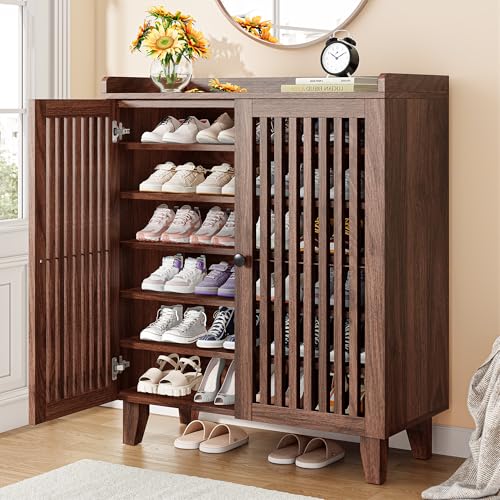
- Holds approximately 24–35 pairs
- Adjustable shelves can fit tall boots
- Slatted doors support airflow and mid-century style
Best For: Families with varied footwear and more available floor space
Best Wide Storage
YOMILUVE 63-Inch Fluted Shoe Cabinet

- Six flip drawers hold almost 30 pairs
- Shallow 9.5-inch depth saves floor space
- Wave-fluted oak design with slipper storage below
Best For: Wide entryways needing high-capacity concealed storage
Best Capacity for Tight Hallways
GRUSIGN Flip-Drawer Shoe Cabinet

- Four tiers hold up to 16 pairs
- Adjustable shelves suit varied footwear
- Top fence and anti-tip kit add practicality
Best For: Compact entryways needing enclosed, high-capacity storage
Best Mid-Century Style

- Dark walnut fluted design with gold handles
- Stores approximately 17–19 pairs
- Waterproof drawers and useful lower shelf space
Best For: Decor-forward entryways needing generous concealed storage
Best Vertical Capacity – VASAGLE 10-Tier Shoe Cabinet
For shoppers comparing shoe cabinets for entryway use, this VASAGLE model makes the most of vertical wall space. Its 73.6-inch height and 10 compartments hold up to 30 pairs while keeping the footprint relatively narrow.
Best For: Households needing high-capacity shoe storage in a space-conscious entryway.
Pros:
- Stores up to 30 pairs in a 12.6-inch-deep cabinet.
- Removable shelves accommodate taller boots.
- Top compartment provides extra room for shoe boxes or baskets.
- Includes an anti-tip kit and numbered assembly parts.
Cons:
- The tall, 73.6-inch profile may not suit rooms with limited vertical clearance.
- Engineered-wood construction has a listed maximum weight capacity of 20 pounds.
This is a strong choice when capacity matters more than a low profile. The clean white finish and streamlined shape also make it easier to integrate into a bedroom or entryway.
Best Hidden Farmhouse Storage – ONBRILL 3-Door Shoe Cabinet
This ONBRILL cabinet is a practical option among shoe cabinets for entryway organization when you want shoes concealed behind doors. Its wide, 43.8-inch design offers room for about 30 pairs, while adjustable shelves help accommodate different footwear.
Best For: Larger entryways that need closed storage, a usable countertop, and farmhouse-inspired styling.
Pros:
- Three doors and six shelves provide organized, hidden storage.
- Separate door section is useful for boots, heels, and other high-top shoes.
- Countertop holds keys, wallets, umbrellas, plants, or decor.
- Five adjustable metal legs and soft-closing hinges support everyday use.
Cons:
- At 43.8 inches wide and 86.3 pounds, it requires more floor space and may be difficult to reposition.
- Assembly is likely easier with two people.
Choose this model if a concealed cabinet look is more important than a narrow footprint. Its cross-molding doors and black finish give the entryway a distinctive rustic-modern appearance.
Best for Narrow Entryways – VASAGLE 2-Drawer Shoe Organizer
Among shoe cabinets for entryway spaces with restricted walkways, this narrow VASAGLE organizer stands out for its 9.4-inch depth and forward-opening flip drawers. It holds 14 to 16 pairs while leaving room underneath for slippers and easier cleaning.
Best For: Compact apartments and narrow hallways where a shallow cabinet is essential.
Pros:
- Shallow 9.4-inch profile helps preserve walkway space.
- Two flip drawers hold up to 14–16 pairs of shoes up to US size 11.
- Adjustable shelves accommodate flats, heels, slippers, or boots when removed.
- Side hooks provide convenient storage for keys and bags.
Cons:
- Boot storage reduces the cabinet’s overall shoe capacity.
- The listed capacity is lower than that of the taller and wider alternatives.
This cabinet prioritizes a small footprint and easy access. Its barn-door styling, honey-brown finish, and raised-edge top make it both a functional organizer and a compact entryway accent.
Best Farmhouse Cabinet – Homleke 2-Door Shoe Cabinet
This Homleke cabinet combines enclosed storage with a compact, furniture-like design, making it a versatile pick among shoe cabinets for entryway use. Its five-tier interior holds 15 or more pairs, and the adjustable shelves can be configured for shoes of different heights.
Best For: Entryways seeking a mid-sized shoe cabinet with farmhouse styling and flexible storage.
Pros:
- Three adjustable shelves support storage for flats, sneakers, and boots.
- Two barn doors conceal shoes and add farmhouse character.
- Can also store bags, accessories, and daily essentials.
- Includes a wall-anchoring device for added stability.
Cons:
- Its 15-plus-pair capacity is lower than the larger 30-pair cabinets.
- The 13.8-inch depth may need more clearance than a narrow flip-drawer model.
With its white finish, wood legs, and black U-shaped handles, this cabinet works well when you want storage that resembles a coordinated piece of entryway furniture. Adjustable shelving adds useful flexibility without making the unit especially large.
Best Narrow Cabinet – Fsbecl Fluted Flip-Drawer Shoe Cabinet
For compact entryways, this walnut Fsbecl shoe cabinet for entryway storage combines a narrow 9.4-inch profile with two hidden flip drawers. Its adjustable shelves and open desktop provide flexible shoe and everyday-item storage without taking up much floor space.
Best For: Small entryways, hallways, and shoppers who want concealed storage in a modern walnut finish.
Pros:
- Narrow design fits tighter spaces while holding approximately 12–16 pairs.
- Removable shelves accommodate different shoe sizes and styles.
- Fluted doors, adjustable feet, and an included anti-tip device add practical and visual appeal.
- Raised base and rear ventilation support easier cleaning and airflow.
Cons:
- Its capacity is more limited than wider six-drawer cabinets.
- Engineered-wood construction requires assembly.
This is a practical pick when entryway width is the main constraint. The two-drawer layout keeps shoes hidden, while the top surface gives you a convenient landing spot for keys, wallets, or decor.
Best for Large Collections – IRONCK 6-Tier Slatted Shoe Cabinet
The IRONCK shoe cabinet for entryway organization offers six tiers and a deeper 14.7-inch cabinet body, making it a strong option for larger households or extensive footwear collections. Slatted doors add airflow, while adjustable shelves help organize shoes of varying heights.
Best For: Families and shoppers who need higher capacity, boot accommodation, and a substantial freestanding cabinet.
Pros:
- Stores approximately 24–35 pairs, depending on shoe size and style.
- Three adjustable or removable shelves can accommodate flats, sneakers, heels, and tall boots.
- Slatted doors promote air circulation and suit the walnut mid-century design.
- Solid wood legs and an anti-tip kit support stability.
Cons:
- At 42.4 inches tall and 14.7 inches deep, it needs more room than narrow cabinets.
- Assembly takes about 40 minutes for two people.
Choose this cabinet when capacity matters more than the smallest footprint. Its adjustable interior is especially useful for mixed footwear, and the top surface can hold plants, lamps, or entryway accessories.
Best Wide Storage – YOMILUVE 63-Inch Fluted Shoe Cabinet
For a wide entryway wall, the YOMILUVE shoe cabinet for entryway storage provides six flip drawers and room for almost 30 pairs while remaining only 9.5 inches deep. Its wave-fluted oak finish adds texture, and the open space beneath the legs can hold slippers.
Best For: Wide hallways or entryways where high capacity and a low-depth design are priorities.
Pros:
- Six drawers provide space for almost 30 pairs of shoes.
- Each drawer has two storage layers with adjustable or removable panels.
- At 9.5 inches deep, it offers substantial capacity without a deep footprint.
- Thick top, wooden legs, and anti-tip hardware provide useful everyday stability.
Cons:
- The 63-inch width requires a long, unobstructed wall.
- Its engineered-wood construction requires assembly.
- It is less suitable for very narrow entryways despite its shallow depth.
This model makes the most sense when horizontal space is available. The six-drawer arrangement keeps footwear hidden and organized, while the top and under-cabinet areas add convenient entryway storage.
Best Arch-Front Pick – Nicetree Fluted Shoe Cabinet
For shoppers seeking shoe cabinets for entryway spaces, the Nicetree combines a slim 9.5-inch depth with a distinctive fluted arch front. Its two flip drawers, adjustable shelves, and wall-mount anti-tipping kit make it a practical choice for narrow hallways and households with varied footwear.
Best For: Design-conscious households needing narrow storage for shoes, including larger sizes and boots.
Pros:
- Slim profile suits small entryways and apartments.
- Adjustable or removable shelves accommodate Size 12+ footwear and different shoe types.
- Fluted mid-century styling and five finish options add decorative appeal.
- Includes reinforced hardware and an anti-tipping kit.
Cons:
- Engineered-wood construction weighs about 40 pounds.
- Wall securing is required for the stated anti-tipping setup.
Choose this model when appearance and flexible storage matter as much as footprint. Its 31.5-inch width and 35.4-inch height provide useful capacity without overwhelming a tight entryway.
Best Capacity for Tight Hallways – GRUSIGN Flip-Drawer Shoe Cabinet
The GRUSIGN is one of the more storage-focused shoe cabinets for entryway use, offering four tiers in a cabinet only 9.45 inches deep. Two flip doors help keep footwear dust-free, while adjustable shelves and an elevated base provide room for different shoe types and slippers.
Best For: Families or households that want compact, enclosed storage for up to 16 pairs.
Pros:
- Four tiers are designed to hold up to 16 pairs.
- Two flip doors open to 60 degrees for easier access.
- Adjustable or removable shelves help accommodate heels and boots.
- Top fence offers a designated spot for keys, plants, or leashes.
Cons:
- The white finish may show hallway dirt more readily.
- Assembly is required.
With a 39.8-inch height and 31.5-inch width, this cabinet prioritizes vertical capacity while preserving floor space. It is a sensible option when concealed organization and a small depth are the main buying priorities.
Best Mid-Century Style – VINGLI Fluted Shoe Cabinet
Among shoe cabinets for entryway spaces, the VINGLI stands out for its dark walnut finish, fluted panels, gold handles, and mid-century profile. Its two waterproof flip drawers and lower space between the metal legs provide storage for approximately 17–19 pairs, depending on shoe size and style.
Best For: Shoppers who want a decorative walnut cabinet with substantial concealed shoe storage.
Pros:
- Two waterproof, easy-to-clean fluted flip drawers.
- Manufacturer states capacity of approximately 17–19 pairs.
- Metal support legs add lower storage space and visual lift.
- Top surface works for decor, plants, or framed photos.
Cons:
- At 62 pounds, it is heavier than the other listed options.
- Its 39.9-inch height may not suit every low-profile entryway.
- Storage capacity varies with shoe size and style.
The VINGLI is a strong fit when entryway furniture needs to function as both storage and decor. Its 9.45-inch depth preserves walkway space, while the walnut finish and fluted detailing give the cabinet a more furniture-like presence.
How We Picked the Best Shoe Cabinets for Entryway Use
We evaluated these shoe cabinets based on the features that matter most in a busy entryway: usable storage capacity, space-saving dimensions, door and drawer design, shelf flexibility, material appearance, stability, and overall practicality. We also considered how easily each cabinet can accommodate different shoe types, including sneakers, flats, boots, and larger men’s footwear.
Because entryways vary widely, the selection includes narrow cabinets for apartments, taller models for families, and decorative options that function as visible furniture rather than basic storage. Product claims such as pair capacity should be treated as estimates, since shoe size and arrangement affect the actual amount each cabinet holds.
Quick Comparison
| Best For | Recommended Style | What to Look For |
|---|---|---|
| Small apartments | Narrow flip-drawer cabinet | Shallow depth and wall clearance |
| Larger households | Tall, multi-tier cabinet | High capacity and sturdy construction |
| Decor-focused entryways | Fluted, slatted, or farmhouse cabinet | Finish, hardware, and visual proportions |
| Mixed shoe collections | Adjustable-shelf cabinet | Flexible interior height |
| Families with children | Easy-access multi-drawer unit | Simple opening and stable placement |
Key Buying Factors for Shoe Cabinets for Entryway Spaces
Measure Depth, Width, and Door Clearance
Measure the wall, baseboards, nearby doors, and walking path before ordering. A cabinet that fits the wall may still obstruct an opening door or make a narrow hallway feel cramped. Flip drawers can be especially useful where floor depth is limited, but they need enough clearance to open fully.
Match Capacity to Your Household
Count the pairs you actually want near the entrance, then allow room for seasonal rotation and irregular footwear. Tall cabinets maximize vertical space, while two-drawer models work better for a small daily collection. Check interior dimensions rather than relying only on advertised pair counts.
Prioritize Adjustable Storage
Adjustable shelves make a cabinet more versatile for boots, high-top sneakers, sandals, and children’s shoes. Fixed compartments can look neat but may waste space when your footwear varies in height.
Check Ventilation, Assembly, and Stability
Closed storage hides clutter, but shoes benefit from airflow. Look for slatted or ventilated doors when odor control matters. Review assembly requirements, anchor tall cabinets where appropriate, and avoid overloading shelves beyond the manufacturer’s guidance.
Who Should Buy Which Shoe Cabinets for Entryway?
Choose a narrow flip-drawer cabinet if your entryway is compact or your main goal is keeping a few everyday pairs out of sight. A tall multi-tier cabinet is the better choice for families or anyone storing a larger collection vertically. For a living-room-adjacent entryway, fluted, slatted, mid-century, or farmhouse finishes can blend with existing furniture. If household footwear varies significantly in size, prioritize adjustable shelves over a fixed layout. Finally, compare measurements and assembly details before choosing the cabinet with the highest advertised capacity.