The best variable speed belt sanders give you more control than single-speed models, making it easier to remove stock quickly, refine edges, smooth wood, or work with metal without overheating the surface.
We compared 10 handheld, benchtop, combination, detail, and 2×72-style machines to help you choose the right balance of belt size, power, speed control, work support, and shop versatility.
Best 10 Variable Speed Belt Sanders Picks for 2026
Best Compact Variable-Speed Pick

- 7.5-amp motor with 620–1,200 FPM variable speed
- Lightweight 6.4-pound handheld design
- Includes dust bag, dust port, and 80-grit belt
Best For: DIY users needing a compact handheld belt sander
Best Heavy-Duty Grinder
JLD 2x72 Variable-Speed Belt Grinder
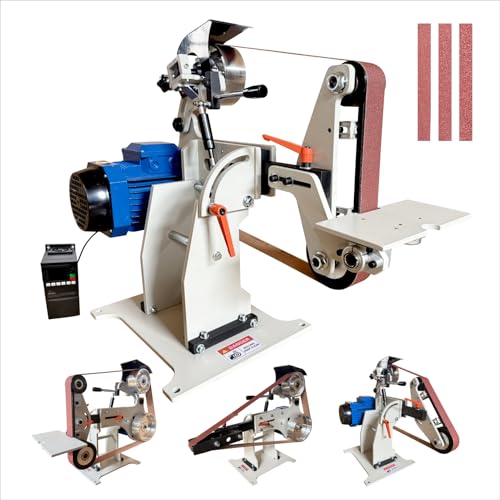
- 1,500W motor with 2.2kW VFD speed control
- Supports circular, flat, and arc grinding
- Includes three belts from 60 to 180 grit
Best For: Metalworking and demanding fabrication projects
Best Handheld-to-Benchtop Option

- 10-amp motor with 660–1,310 FPM variable speed
- Works handheld or as an upward-facing benchtop sander
- Includes mounting hardware, dust bag, and two belts
Best For: Workshops needing portable and stationary sanding
Best Vertical/Horizontal Bench Sander

- Vertical and horizontal operating positions
- Stepless VFD speed control for varied materials
- Includes 100-, 180-, and 240-grit belts
Best For: Bench grinding, polishing, deburring, and knife sharpening
Best Variable-Speed Combo Sander
RIKON 50-161VS 1 x 30-Inch Belt / 6-Inch Disc Sander
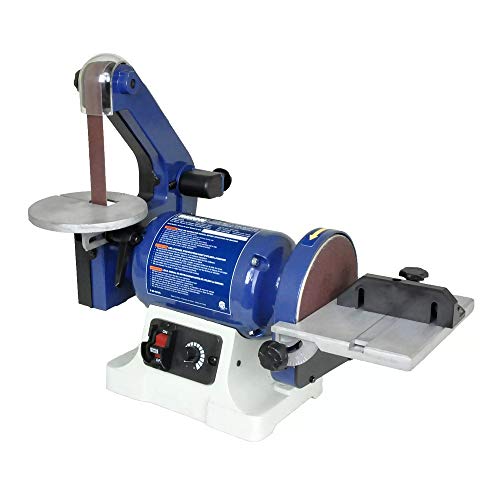
- Variable speed from 2,000 to 3,400 RPM
- 1 x 30-inch belt plus 6-inch disc
- Tilting tables and dual dust ports
Best For: Small-shop shaping, smoothing, and angled sanding
Best Long-Belt Benchtop Sander
WEN 6502T 4 x 36-Inch Belt and 6-Inch Disc Sander
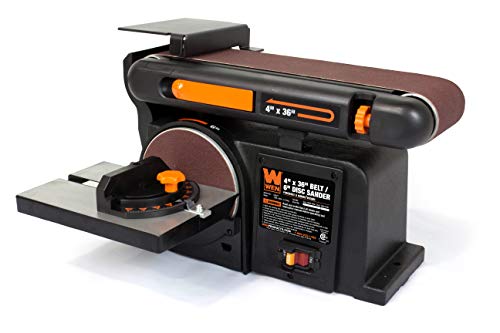
- Long 4 x 36-inch sanding belt
- 0–90-degree belt tilt
- Cast iron base and 4.3-amp motor
Best For: Stable general-purpose benchtop sanding
Best for Knife Making
1 x 30 Variable Speed Belt Sander with KSAG-5

- VFD variable-speed control up to 5,000 RPM
- Forward/reverse belt direction
- KSAG-5 angle guide and steel construction
Best For: Knife making, bevel grinding, and metal finishing
Best Versatile Combo
1" x 30" Variable-Speed Belt & Disc Sander

- Adjustable belt and disc speeds
- 3/4 HP direct-drive motor
- Includes tables and miter gauge
Best For: Mixed wood, metal, sharpening, and contour-sanding tasks
Best Detail Pick
WEN 6307 Variable-Speed File Sander
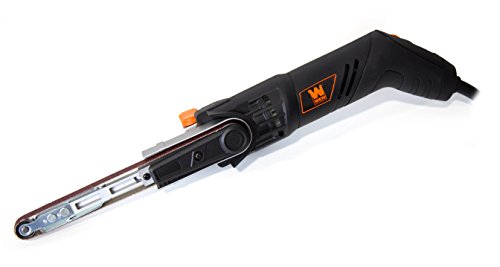
- 1080–1800 FPM variable speed
- 55-degree pivoting belt arm
- Auto-tracking, tool-free belt changes
Best For: Light detail sanding and tight-area shaping
Best Workshop Belt Size
4" x 36" Variable-Speed Belt Disc Sander

- 4" x 36" belt with 6-inch disc
- Horizontal or vertical belt operation
- 1060–2110 FPM belt speed
Best For: Home workshops, edge sanding, and general DIY finishing
Best Compact Variable-Speed Pick – WEN HB321V Belt Sander
WEN 7.5-Amp 3-by-21-Inch Variable Speed Handheld Portable Belt Sander (HB321V)
Check Price On AmazonThe WEN HB321V is a practical choice among variable speed belt sanders for general wood sanding, edge work, and small-to-medium projects. Its 7.5-amp motor adjusts from 620 to 1,200 feet per minute, while the 6.4-pound design helps limit fatigue during handheld use.
Best For: DIY users who want a lightweight, corded 3-by-21-inch belt sander with adjustable speed.
Pros:
- Variable speed from 620 to 1,200 feet per minute
- Compact 6.4-pound design supports more comfortable handheld sanding
- Includes a dust bag, 1-1/4-inch dust port, and 80-grit belt
- Quick-release tension lever makes belt changes faster
Cons:
- Its 3-by-21-inch format has less sanding area than larger models
- Includes an 80-grit belt, so additional grits may be needed for finishing work
Choose this model when portability and straightforward speed control matter more than stationary operation or heavy-duty metal grinding. The lock-on switch and dust-collection options add convenience for repeated sanding tasks.
Best Heavy-Duty Grinder – JLD 2×72 Variable-Speed Belt Grinder
The JLD Professional Belt Grinder is a substantial option among variable speed belt sanders for demanding grinding and fabrication work. Its 1,500W motor works with a 2.2kW VFD for stepless adjustment from 0 to 2,800 rpm, and its steel frame is designed for prolonged operation.
Best For: Metalworkers and fabricators who need adjustable speed, multiple grinding configurations, and a large 2-by-72-inch belt format.
Pros:
- Powerful 1,500W pure copper motor for heavy-duty grinding
- VFD provides smooth, stepless speed adjustment from 0 to 2,800 rpm
- Supports circular, flat, and arc grinding with two included kits
- Includes 60-, 100-, and 180-grit sanding belts
Cons:
- Large 30-by-24-by-18-inch footprint requires dedicated workspace
- More specialized and less portable than handheld belt sanders
- Setup includes a power transformer and multiple components
This is the strongest fit for users who prioritize capacity, speed control, and versatility over compact storage. The included belt range covers coarse removal through finer refinement, while the rigid steel frame is suited to extended grinding sessions.
Best Handheld-to-Benchtop Option – WEN HB424V Belt Sander
WEN 10-Amp 4-by-24-Inch Variable Speed Combination Handheld and Benchtop Belt Sander (HB424V)
Check Price On AmazonThe WEN HB424V stands out among variable speed belt sanders because it can be used handheld or attached to a benchtop for upward-facing stationary sanding. Its 10-amp motor offers belt speeds from 660 to 1,310 feet per minute, giving users useful control across different sanding tasks.
Best For: DIYers who want one 4-by-24-inch sander for both portable work and benchtop sanding.
Pros:
- 10-amp variable-speed motor adjusts from 660 to 1,310 feet per minute
- Converts to benchtop use with the included mounting pad and clamps
- Quick-release belt tension lever simplifies belt changes
- Includes two 80-grit belts and a detachable dust bag
Cons:
- Larger 4-by-24-inch format may be less convenient for tight spaces
- Included belts are both 80-grit, limiting out-of-box grit variety
The HB424V is a versatile middle ground for a workshop that needs both handheld flexibility and stationary support. It is especially appealing when a larger sanding surface and stronger 10-amp motor are useful, but a dedicated industrial grinder would be excessive.
Best Vertical/Horizontal Bench Sander – GOLDSAND GD-SDJ-8 Belt Sander
The GOLDSAND GD-SDJ-8 is a bench-style choice among variable speed belt sanders, offering vertical and horizontal operation along with stepless speed adjustment. Its 550W motor runs at up to 5,500 rpm, while the included 100-, 180-, and 240-grit belts support work from coarse grinding to finer sanding.
Best For: Users who need a compact bench sander for metal, wood, plastic, glass, deburring, polishing, or knife sharpening.
Pros:
- Supports both vertical and horizontal sanding positions
- Stepless VFD speed control adapts to fast grinding or finer sanding
- Includes 100-, 180-, and 240-grit zirconia corundum belts
- Detachable workbench and steel frame add setup flexibility and stability
Cons:
- Its 1-by-30-inch belt is narrower than the JLD model’s 2-by-72-inch format
- Bench-style design is less suited to large handheld sanding surfaces
- Requires an electrical connection and dedicated operating space
This model makes sense for users who value angle flexibility and a broad included grit selection in a relatively compact bench setup. The adjustable workbench and reversible orientation are useful for varied grinding, polishing, and sharpening positions.
Best Variable-Speed Combo Sander – RIKON 50-161VS 1 x 30-Inch Belt / 6-Inch Disc Sander
The RIKON 50-161VS is a versatile choice among variable speed belt sanders for small-shop shaping, smoothing, and detail work. Its 3/4 HP motor adjusts from 2,000 to 3,400 RPM, while the 1 x 30-inch belt and 6-inch disc provide two sanding surfaces in one benchtop machine.
Best For: Woodworkers who want variable-speed belt and disc sanding with adjustable tables and dust-collection support.
Pros:
- Variable speed supports belt speeds from 1,909 to 3,248 SFPM.
- Tilting belt and disc tables handle straight and angled sanding.
- Includes a miter gauge, belt-tracking adjustment, dual dust ports, and base-mounting holes.
Cons:
- The 1 x 30-inch belt is better suited to smaller projects than large surfaces.
- At 30.2 pounds, it is substantial for a compact benchtop sander.
Choose this RIKON when control and versatility matter more than maximum sanding area. The adjustable speed, angled tables, and two sanding surfaces make it a practical all-around option for controlled shop work.
Best Long-Belt Benchtop Sander – WEN 6502T 4 x 36-Inch Belt and 6-Inch Disc Sander
WEN Benchtop Belt and Disc Sander with 4 x 36 in. Belt, 6 in. Disc and Cast Iron Base (6502T)
Check Price On AmazonThe WEN 6502T combines a long 4 x 36-inch belt with a 6-inch disc for general-purpose benchtop sanding. Although it does not offer adjustable speed, its 4.3-amp motor reaches up to 3,600 RPM, and the cast iron base is designed to reduce heavy vibrations.
Best For: Users who prioritize a longer sanding belt, solid benchtop stability, and straightforward belt-and-disc capability.
Pros:
- The 4 x 36-inch belt provides more sanding area than compact 1 x 30-inch models.
- Belt tilts from 0 to 90 degrees for varied sanding positions.
- Cast iron base helps prevent heavy vibrations, and the tension-release lever simplifies abrasive changes.
Cons:
- It is not a variable-speed model.
- The supplied notes do not specify dust-collection ports or a miter gauge.
This WEN is worth considering if belt length and stability are more important than speed adjustment. For shoppers specifically comparing variable speed belt sanders, its fixed-speed design is the main trade-off.
Best for Knife Making – 1 x 30 Variable Speed Belt Sander with KSAG-5
This 1 x 30-inch machine is a specialized option among variable speed belt sanders, built for sharpening, bevel grinding, polishing, and metal fabrication. Its VFD control supports smooth speed adjustment, while forward/reverse operation and horizontal or vertical setups help adapt the sander to different grinding tasks.
Best For: Knife makers and metalworkers who need controlled bevel grinding, sharpening, and finishing.
Pros:
- VFD control allows speed adjustment for stock removal, sharpening, polishing, and finishing.
- Forward and reverse belt direction can improve visibility and reduce burr formation.
- Includes the KSAG-5 angle guide, contact wheel, flat platen, and horizontal/vertical work rest.
- Welded all-steel construction is designed for rigidity, stable tracking, and reduced vibration.
Cons:
- Its specialized grinding features may be unnecessary for basic woodworking.
- The 1 x 30-inch belt format offers less surface area than larger belt sanders.
- The supplied notes do not identify a dust-collection system.
For blades, bevels, and metal finishing, this model offers more specialized control than a general-purpose belt-and-disc sander. Its angle guide, reversible belt direction, and interchangeable grinding setup make it the most task-focused option in this group.
Best Versatile Combo – 1" x 30" Variable-Speed Belt & Disc Sander
This compact benchtop combo is a practical choice among variable speed belt sanders when you want both detail sanding and flat-surface work in one machine. Its adjustable belt and disc speeds help accommodate delicate shaping, sharpening, smoothing, and more aggressive stock removal.
Best For: Woodworkers, metalworkers, knife makers, and DIY users who need belt-and-disc versatility in a space-saving setup.
Pros:
- Variable belt speed from 1909 to 3248 SFPM and disc speed from 2000 to 3400 RPM.
- 3/4 HP direct-drive motor provides consistent torque with less maintenance than belt-driven designs.
- Includes adjustable work tables, a disc-side miter gauge, and a removable belt cover for round-corner sanding.
Cons:
- The 1″ x 30″ belt is better suited to detail and edge work than large-surface sanding.
- It is a corded benchtop machine, so it requires a suitable workshop setup.
Choose this model if you value broad functionality and adjustable speed more than a larger sanding surface. The dual-station design makes it especially useful for mixed projects involving edges, contours, bevels, and finishing.
Best Detail Pick – WEN 6307 Variable-Speed File Sander
The WEN 6307 is a lightweight option among variable speed belt sanders, designed for controlled detail work in tight areas. Its narrow 1/2-by-18-inch belt and adjustable speed make it suitable for shaping and smoothing where a full-size sander would be cumbersome.
Best For: Detail sanding, small workpieces, and users who want a compact file-style sander with a pivoting arm.
Pros:
- Variable speed dial adjusts the belt from 1080 to 1800 feet per minute.
- Pivoting belt arm moves up to 55 degrees for access to different sanding angles.
- Auto-tracking and tool-free belt installation simplify operation and belt changes.
Cons:
- The narrow 1/2-inch belt is intended for detail work rather than broad surfaces.
- Its 2.4-pound design and 2-amp capacity are geared toward lighter-duty sanding.
This is a focused tool rather than an all-purpose bench sander. Its compact profile, speed control, and pivoting arm make it a sensible choice when precision access matters more than high-volume material removal.
Best Workshop Belt Size – 4" x 36" Variable-Speed Belt Disc Sander
This benchtop combo offers a larger sanding belt than many compact variable speed belt sanders, while retaining adjustable speeds for different materials and project stages. The horizontal or vertical belt position adds flexibility for edge sanding, surface smoothing, and stock removal.
Best For: Home workshops and DIY users who want a 4″ x 36″ belt, 6-inch disc, and flexible belt orientation.
Pros:
- Adjustable belt speed ranges from 1060 to 2110 FPM, while disc speed ranges from 2000 to 4000 RPM.
- 4″ x 36″ belt and 6-inch disc support edge work, surface smoothing, detail sanding, and finishing.
- Horizontal or vertical belt operation and a higher work stop improve setup flexibility and support.
Cons:
- The supplied notes identify it as a benchtop machine for home workshops, not a floor-standing production sander.
- Its 3-amp motor and compact format may be less suited to continuous heavy-duty use.
Consider this model when belt size and positioning are priorities. It combines a relatively broad sanding belt with a disc station and speed adjustment, making it a flexible option for everyday DIY and woodworking tasks.
How We Picked the Best Variable Speed Belt Sanders
We evaluated these Variable Speed Belt Sanders across the features that most affect real-world performance: motor output, adjustable speed range, belt dimensions, tracking and tension systems, workpiece support, sanding orientation, dust-management options, and overall versatility. We also considered whether each design is better suited to handheld woodworking, benchtop fabrication, knife sharpening, metal grinding, or detail work.
Because no single sander is ideal for every task, the selection includes compact 1-by-30-inch machines, larger 3-by-21- and 4-by-24-inch handheld sanders, belt-and-disc combinations, a narrow file sander, and heavy-duty 2×72-inch equipment.
Quick Comparison
- Best for general handheld sanding: A 3-by-21-inch variable-speed model offers a useful balance of coverage, maneuverability, and control.
- Best for large surfaces: A 4-by-24-inch handheld sander removes material quickly from wide boards and substantial workpieces.
- Best for compact shops: A 1-by-30-inch belt-and-disc combination provides multiple functions without taking up much bench space.
- Best for detail work: A narrow file sander reaches inside corners, contours, and other confined areas.
- Best for serious metalwork: A 2×72-inch grinder with a VFD offers the belt length, power, and speed control expected for fabrication and knife grinding.
- Best for stationary sanding: Benchtop belt-and-disc designs provide stable support for repeatable edge and surface work.
Key Buying Factors for Variable Speed Belt Sanders
Belt Size and Sanding Area
Wider and longer belts cover more material per pass and usually run cooler during demanding work. Smaller belts are easier to control and better for edges, small parts, and detail sanding. A 2×72-inch belt is a specialized format with broad accessory and abrasive options for metalworking.
Speed Range and Motor Power
Adjustable speed lets you slow down for heat-sensitive finishes, plastics, sharpening, and delicate edges, or increase speed for aggressive stock removal. More motor power helps maintain belt speed under load, but it can also make a machine heavier and harder to control by hand.
Handheld or Benchtop Design
Handheld sanders are flexible for boards, floors, and large workpieces, while benchtop units provide better stability and repeatability. Combination models add a disc sander, which is useful for end grain, bevels, and small parts.
Support, Tracking, and Safety
Look for dependable belt tracking, easy tension release, a stable platen or work table, and accessible controls. For metal grinding, confirm that guards and spark management suit your workspace. Eye protection, hearing protection, dust collection, and appropriate respirators remain essential.
Who Should Buy Which Variable Speed Belt Sanders?
Woodworkers and DIYers should prioritize a versatile 3-by-21-inch handheld model or a benchtop belt-and-disc sander. Users working on large boards may prefer the faster coverage of a 4-by-24-inch design. Knife makers and metal fabricators should look toward a 2×72-inch grinder or a sturdy vertical-and-horizontal metalworking model. Detail-focused users will get the most benefit from a narrow file sander, while small-shop owners should consider a compact combination unit that performs several tasks in one footprint.